Reserve
← All cenotes

Deep

Cenote El Pit

An almost cylindrical shaft that drops far beyond where recreational diving goes. It has a halocline, hydrogen sulphide, stalactites several metres long and, in the right months, sunbeams that reach all the way down. Advanced Open Water is required, which is why it is one of the quietest cenotes of the day.

Dive depth
30 m
Cenote depth
142 m
Card to show
Advanced Open Water or Deep
From Tulum, straight line
14 km NE

Dive it with us

Reserve a dive
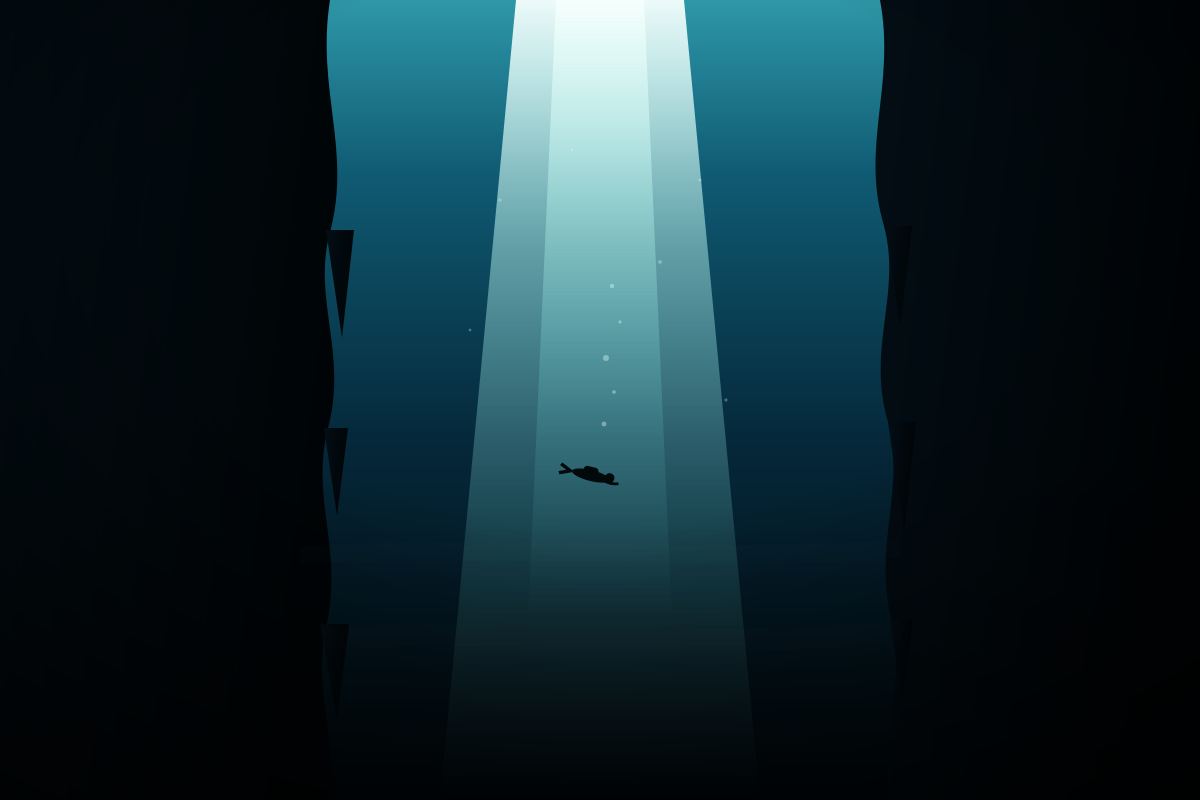
Shafts of light dropping down the well of El Pit, divers in silhouette

Dive map

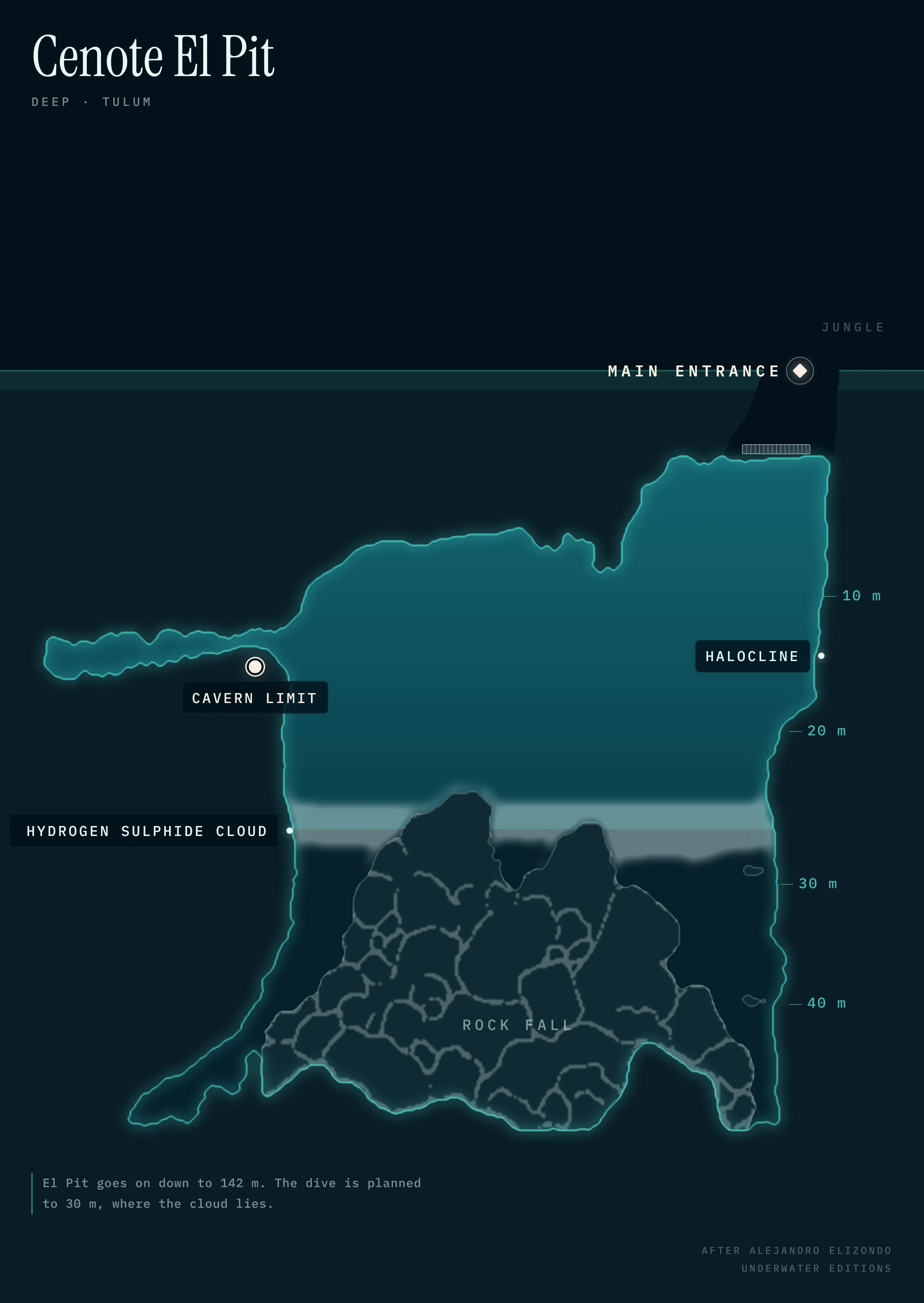
Cross-section of Cenote El Pit: the entrance shaft, depths to 40 m, the halocline and hydrogen sulphide cloud, and the cavern limitOpen full size ↗
Drawn for orientation, not navigation: your guide briefs the route at the cenote. Redrawn from the map by Alejandro Elizondo (Underwater Editions).

Where it is and what it connects to

El Pit is inside the Dos Ojos park. In fact, about twelve metres down there is a cave that, dived for some two and a half hours, comes out in Dos Ojos right at the Barbie doll — but only a cave-certified diver can do that.

The entry and the descent

To start you walk down a long platform, a little intimidating to look at but perfectly safe. At the bottom, fins on and a giant stride in. Once everyone is ready we switch on our torches and begin a slow descent.

The halocline

The first fourteen metres are fresh water. Then comes the halocline, where fresh water and salt water meet. Visibility drops a little there: the halocline makes the water look thick — I always compare it to how oil looks in water. Past it, at around fifteen metres, it is salt water the rest of the way.

The hydrogen sulphide and the island on the bottom

As at Angelita, there is an island on the bottom built from trees and rocks that have fallen over thousands of years. There is hydrogen sulphide here too, at thirty metres, though it is not as dense as Angelita's and does not give the same visual effect. It is still well worth seeing.

How deep we go

At thirty metres we begin ascending slowly in a circle: the cenote is close to cylindrical. El Pit is one of the deepest caves in the region, reaching a hundred and forty-two metres, though on our dives you only make out the first forty or so.

The light beams

On the way up is when the sunbeams come into their own, coming down and dancing under the water.

The stalactites overhead

The ceiling carries an enormous number of stalactites, some over two or three metres. A stalactite takes about four thousand years to grow a metre, and it only grows in a semi-dry environment: once it is underwater it stops growing for good.

What the archaeologists found

When archaeologists explored this place they found human remains some eight thousand years old, from the cave-dweller era. Also animal remains from the end of the last ice age, among them a giant sloth that is still inside one of these caves — that one is only reachable with a cave certification, because it is not in the cavern zone.

When to go

The sunbeams show between late March and late September, and within the day between 8:30 and 12, because of the angle the sun comes in at. From September to November and from January through most of March you barely see the effect. Worth saying plainly: the dive is beautiful with or without the light, but the light takes it somewhere else.

Going on your own

No snorkelling here. El Pit is for diving and freediving only, and since it also asks for Advanced Open Water as a minimum, it is one of the quietest cenotes in the area.

Questions

How deep is El Pit?

A hundred and forty-two metres — one of the deepest caves in the region. Our dives are planned to thirty, and from there you make out about forty.

When can you see the light beams?

Between late March and late September, and between 8:30 and 12 in the day. From September to November and from January through most of March you barely see them. The dive is beautiful either way, but the light takes it somewhere else.

What is the halocline?

The point where fresh water meets salt water, around fourteen or fifteen metres. It makes the water look thick and costs you some visibility — it looks the way oil looks in water. Once you are through it, everything is sharp again.

What certification do I need?

Advanced Open Water as a minimum. It is a deep dive, and that requirement is also why there are so few people here.

Can you snorkel at El Pit?

No. It is for diving and freediving only.

Is the giant sloth real?

Yes. Animal remains from the end of the last ice age have been found in these caves, among them a giant sloth that is still in there. It is not in the cavern zone, so it can only be reached with a cave certification.

A single column of light falling down the deep shaft of El Pit.
A single column of light falling down the deep shaft of El Pit. An illustration of the kind of dive, not a map of this cenote.

Loading the map…

Nearby

A diver with a torch lit swimming through a pale rock gallery in Cenote Tak Be LuumTO 7 M

Cavern

Cenote Tak Be Luum

Less known, and so less touched, this cenote lies in the Dos Ojos park area. It offers cavern passages with well-preserved formations, calm water and a more intimate dive, since it sees fewer visitors. Ideal if you want to explore cenotes off the busiest routes.

Card to show
Open Water or equivalent
See the cenote
A diver crossing the halocline, the shimmering layer where fresh water meets salt.TO 18 MIllustration — photo coming soon

Cavern

Cenote Tak Be Ha

A cave system with wide chambers, sharply defined stalactites and stalagmites, and a strong halocline that blurs the view where fresh and salt water mix. Calm and never crowded, it is ideal for certified divers looking for spectacular formations.

Card to show
Open Water or equivalent
See the cenote
Divers in the cavern at Dos Ojos, daylight piercing the blue water10 M

Cavern

Cenote Dos Ojos

Two connected bodies of water that, seen from above, look like a pair of eyes. They belong to the longest flooded cave system in the world — some 369 kilometres of it — and are dived as cavern: daylight always present, the exit always in sight. This is the cenote most people start with, and Open Water is enough.

Card to show
Open Water or equivalent
Snorkel
Good for snorkelling too
See the cenote