Reserve
← All cenotes

Cavern

Cenote Dos Ojos

Two connected bodies of water that, seen from above, look like a pair of eyes. They belong to the longest flooded cave system in the world — some 369 kilometres of it — and are dived as cavern: daylight always present, the exit always in sight. This is the cenote most people start with, and Open Water is enough.

Dive depth
10 m
Card to show
Open Water or equivalent
From Tulum, straight line
15 km NE
Snorkel
Good for snorkelling too

Dive it with us

Reserve a dive
Divers in the cavern at Dos Ojos, daylight piercing the blue water

Dive map

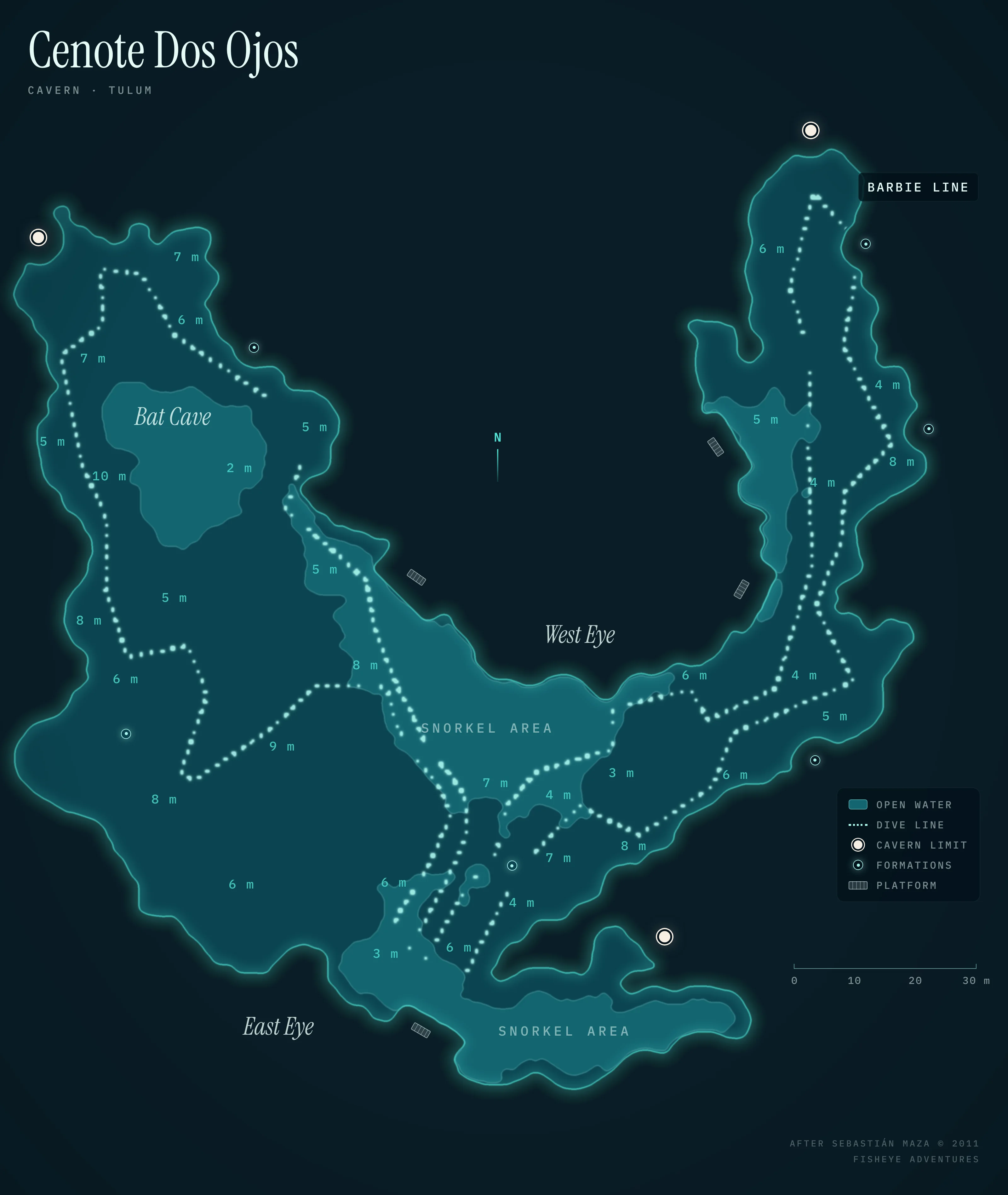
Dive map of Cenote Dos Ojos: the dive lines, the Barbie Line and the Bat Cave, depths, formations and cavern limitsOpen full size ↗
Drawn for orientation, not navigation: your guide briefs the route at the cenote. Redrawn from the map by Sebastián Maza (Fisheye Adventures, 2011).

The two eyes

It is a semi-open cenote. At water level there is a platform that splits the area in two: one side for divers, the other for snorkellers. The platform sits in the east eye — the other is the west eye, and that is where the name comes from, because in Mexico a roundish body of water of a certain size is called an ojo de agua, an eye of water.

Getting into the water

We kit up at the parking area above and walk down ready to get in. There are two ways into the water: sit on the steps, put your fins on and enter from there, or put them on standing at the edge of the platform and take a giant stride forward.

Before we start we run a buoyancy check. We do it on anyone's first cenote dive, without exception: fresh water does not hold you the way salt water does, and most people need to adjust the weight they would use in the sea.

The Barbie Line

There are two different dives here. Both start in the east eye and finish in the west eye, but they take in different parts of the cavern. The Barbie Line is named for the Barbie doll tied to the line at the halfway point — it is the marker that tells you you are exactly half way. It is the brighter of the two, and the longer.

The Bat Cave

The Bat Cave is darker and far less exposed to the light. With about a third of the dive left we surface inside a chamber with bats and stalactite formations — fruit bats, the ones that live on fruit. Hence the name. Both dives are beautiful and both stay with you.

When to go

Dive it early. It is one of the most popular cenotes in the area, and by mid-morning there are considerably more people in the water — especially in high season.

Going on your own

Yes, you can snorkel here, in the area the platform keeps separate from the divers. The park's rules have changed over the years: swimming is now only allowed with a life jacket. The bat chamber can be explored on snorkel too.

Questions

Do I need a certification to dive Dos Ojos?

Open Water is enough. This is cavern diving, not cave diving: daylight is the primary light source and the exit is always in sight, following the guideline.

Why is it called Dos Ojos?

For the two connected bodies of water that make up the site, the east eye and the west eye. In Mexico a roundish body of water of a certain size is called an ojo de agua — an eye of water.

What is the difference between the Barbie Line and the Bat Cave?

The Barbie Line is the brighter route and the longer one; a Barbie doll is tied to the line at the halfway point as a marker. The Bat Cave is darker, and a third from the end you surface in a chamber with fruit bats and stalactites.

How deep is it?

The dives stay within ten metres. This is a dive about light and formations, not about depth.

Can you snorkel at Dos Ojos?

Yes, in the area kept separate from the divers. The park changed its rules and swimming is now only allowed with a life jacket. The bat chamber can be seen on snorkel as well.

What time should I get there?

Early. It is one of the most visited cenotes and it fills up quickly, especially in high season.

In the water: Barbie Line and Bat Cave

Photos and video from our latest dive at Dos Ojos.

Our latest dive at Dos Ojos: along the guideline with torches, through the formations
A diver crossing the sandy floor of Dos Ojos, torch lit, under shafts of daylight
A diver framed by a rock arch and columns in Dos Ojos, following the guideline
A blue fin in the foreground and another diver's torch behind it, in the darker passages of Dos Ojos
A diver lighting up the pale rock with a torch, bubbles rising, in Dos Ojos
A diver beside a great block of white rock, next to the guideline, in Dos Ojos
A diver's torch among stalactites and columns in the cavern of Dos Ojos
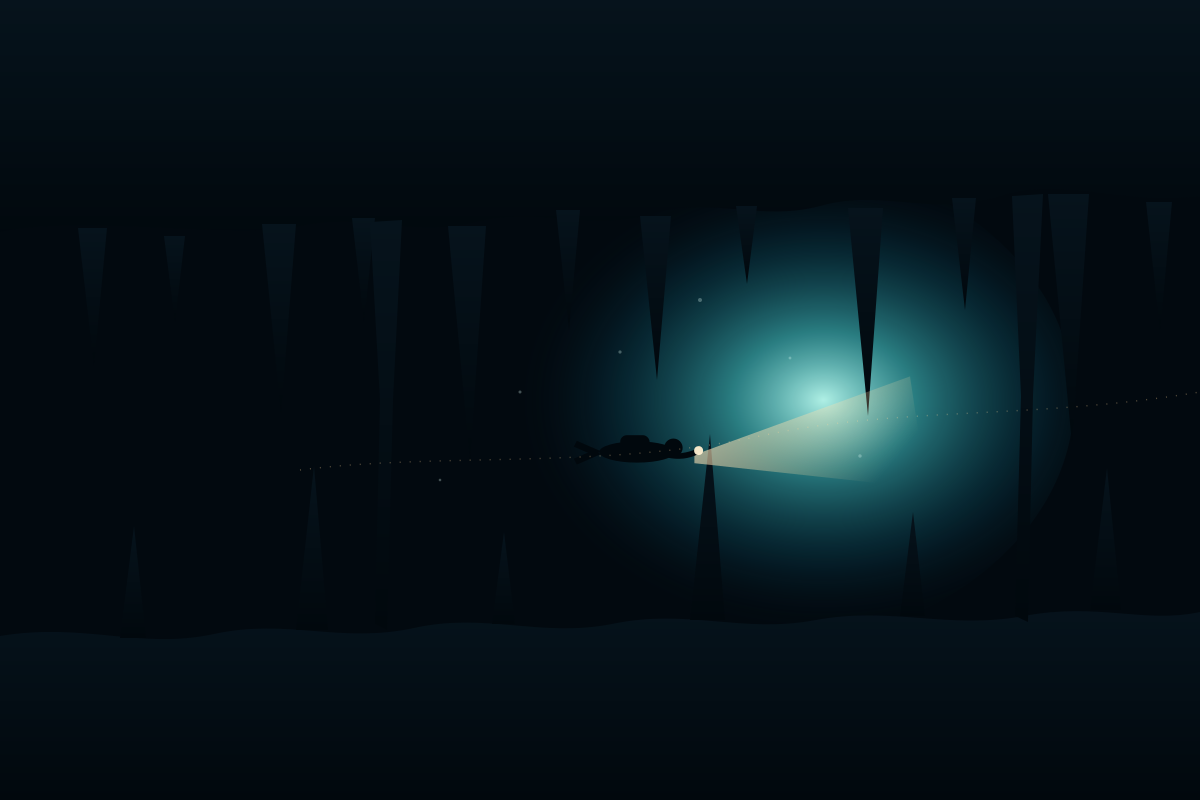
A cavern dive: stalactites and stalagmites framing the blue exit in the distance. Daylight is never out of sight.
A cavern dive: stalactites and stalagmites framing the blue exit in the distance. Daylight is never out of sight. An illustration of the kind of dive, not a map of this cenote.

Loading the map…

Nearby

A diver crossing the halocline, the shimmering layer where fresh water meets salt.TO 18 MIllustration — photo coming soon

Cavern

Cenote Tak Be Ha

A cave system with wide chambers, sharply defined stalactites and stalagmites, and a strong halocline that blurs the view where fresh and salt water mix. Calm and never crowded, it is ideal for certified divers looking for spectacular formations.

Card to show
Open Water or equivalent
See the cenote
The clear turquoise water of Cenote Nicte-Ha, dotted with water lilies, below a wall of rock and jungleTO 8 M

Open cenote

Cenote Nicte-Ha

Close to Dos Ojos, it stands out for its aquatic plants and its emerald water, coloured by water lilies and underwater vegetation. Shallower than the other cenotes around it, it is ideal for snorkelling and easy dives, with good visibility and a very photogenic, natural setting.

Card to show
Open Water or equivalent
Snorkel
Good for snorkelling too
See the cenote
A diver with a torch lit swimming through a pale rock gallery in Cenote Tak Be LuumTO 7 M

Cavern

Cenote Tak Be Luum

Less known, and so less touched, this cenote lies in the Dos Ojos park area. It offers cavern passages with well-preserved formations, calm water and a more intimate dive, since it sees fewer visitors. Ideal if you want to explore cenotes off the busiest routes.

Card to show
Open Water or equivalent
See the cenote