Reserve
← All cenotes

Cavern

Cenote Car Wash

Aktun Ha

Kay's favourite cenote, and one of the best to start with. A short, shallow dive that gives you the loveliest postcard of them all: the open water seen from inside the cavern, looking out. Its Maya name is Aktun Ha; the name Car Wash came from the cars that used to stop and get washed at the roadside.

Dive depth
16 m
Card to show
Open Water or equivalent
From Tulum, straight line
7 km N
Snorkel
Good for snorkelling too

Dive it with us

Reserve a dive
A rope hanging over the clear water of Cenote Car Wash, fringed by jungle, near Tulum

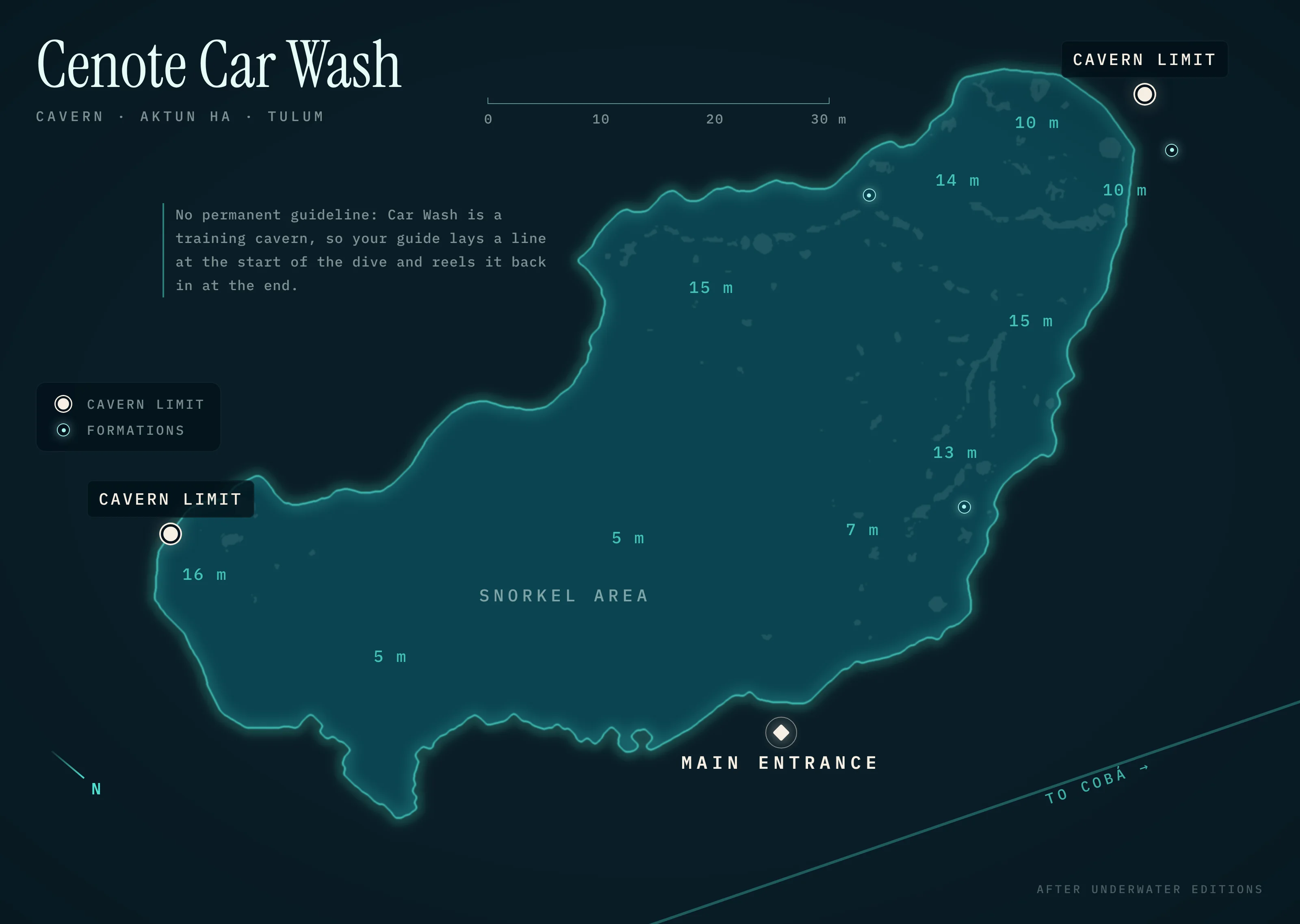
Dive map

Dive map of Cenote Car Wash: depths of 5 to 16 m, formations, the two cavern limits and the main entranceOpen full size ↗
Drawn for orientation, not navigation: your guide briefs the route at the cenote. Redrawn from the map by Underwater Editions.

Where the name comes from

Its Maya name is Aktun Ha, which means flooded cave, or cave with water. The name everybody uses is much more recent and far more prosaic: the cenote sits right beside the highway, and years ago, long before Tulum was a tourist destination, locals and people driving past would stop to fetch buckets of water and wash their cars. The name stuck.

What the dive is like

It is a short dive, and that is worth saying up front: it is not the longest we run. Maximum depth is sixteen metres, so it does take a safety stop at the end, but on average it stays well above that. Shallow, short, with the open water never far away — that combination makes it one of the best cenotes for someone just getting into cenote diving. Open Water is enough.

The postcard from inside the cavern

There is one moment that, for Kay, justifies the whole cenote. You are inside the cavern with the darkness behind you, looking back out towards the open area: daylight comes in from a single direction and cuts the silhouette of the entrance out against the water. It is one of the finest images any cenote around here gives you, and it is the reason this one is his favourite.

The formations

Car Wash has very large stalactites and stalagmites — among the biggest you will see on a shallow cavern dive. They formed while the cave was dry; once it flooded they stopped growing for good, so what you see today is exactly what was left when the sea came up.

The Maya pot

The remains of a Maya pot were found inside the cenote, and they are still there. They were not lifted out or put in a display case: they lie where they were found, and you pass beside them during the dive. It is one of the rare chances to see a piece like that in place, underwater, rather than behind glass.

Life in the open area

The open area has beautiful vegetation and noticeably more fish than most cenotes around here, which tend to be emptier. Cormorants sometimes come down to fish underwater, and watching that from below is a strange thing to witness. Land turtles live around the edges too, among other species.

What it pairs with

The usual pairing is Car Wash with Angelita: one short, bright and shallow, the other deep and strange. They work well together precisely because they have nothing in common.

Questions

What does Aktun Ha mean?

Flooded cave, or cave with water, in Maya. It is the cenote's original name; Car Wash is the nickname that stuck later.

Why is it called Car Wash?

Because it sits right by the highway. Years ago, before Tulum was a tourist town, locals and passers-by would stop to fetch buckets of water and wash their cars there.

How deep is Car Wash?

Sixteen metres at most. That is why it takes a safety stop at the end, although the dive stays well above that depth on average.

Do I need experience to dive it?

Not much. Open Water is enough, and it is one of the cenotes we most recommend to people just starting out: shallow, short, and with the open water never far away.

Is there really a Maya pot inside?

Yes. The remains of a Maya pot were found in the cenote and are still in place, visible during the dive.

What animals will I see at Car Wash?

More fish than in most cenotes. Cormorants sometimes dive down to fish underwater, and land turtles live around the edges, among other species.

Which other cenote is it usually combined with?

Angelita. It is the pairing people ask for most: a short, bright dive followed by a deep and completely different one.

Sunbeams piercing turquoise water, limestone walls and a diver on the way down.
Sunbeams piercing turquoise water, limestone walls and a diver on the way down. An illustration of the kind of dive, not a map of this cenote.

Loading the map…

Nearby

The turquoise water of Cenote Nohoch Nah Chich under a rock overhang, wooden steps leading down into itTO 8 M

Cavern

Cenote Nohoch Nah Chich

Part of one of the longest underwater cave systems in the world. It is known for an astonishing concentration of stalactites and stalagmites, many of them huge, forming real stone “forests” underwater. Its crystal-clear water and intricate passages make it a must for experienced cavern divers looking for formations on another level.

Card to show
Open Water or equivalent
See the cenote
Shafts of light dropping down the well of El Pit, divers in silhouette30 M

Deep

Cenote El Pit

An almost cylindrical shaft that drops far beyond where recreational diving goes. It has a halocline, hydrogen sulphide, stalactites several metres long and, in the right months, sunbeams that reach all the way down. Advanced Open Water is required, which is why it is one of the quietest cenotes of the day.

Card to show
Advanced Open Water or Deep
See the cenote
The clear turquoise water of Casa Cenote, ringed by mangrove, near Tulum9 M

Open cenote

Casa Cenote

The odd one out. Casa Cenote is where a system of underground rivers ends and empties into the sea, so its water is brackish — fresh mixed with salt — and a degree warmer than anywhere else. That gives it wildlife no other cenote has, a crocodile among it. No certification needed, and it is an excellent place to snorkel.

Card to show
None — try it with Discover Scuba
Snorkel
Good for snorkelling too
See the cenote