Reserve
← All cenotes

Deep

Cenote Angelita

The strangest cenote we dive. A layer of hydrogen sulphide turns the bottom into what looks like a river with an island in the middle, and crossing it changes the dive completely. Deep, vertical, connected to no other cave — it calls for Advanced Open Water.

Dive depth
30 m
Cenote depth
57 m
Card to show
Advanced Open Water or Deep
From Tulum, straight line
14 km SW

Dive it with us

Reserve a dive
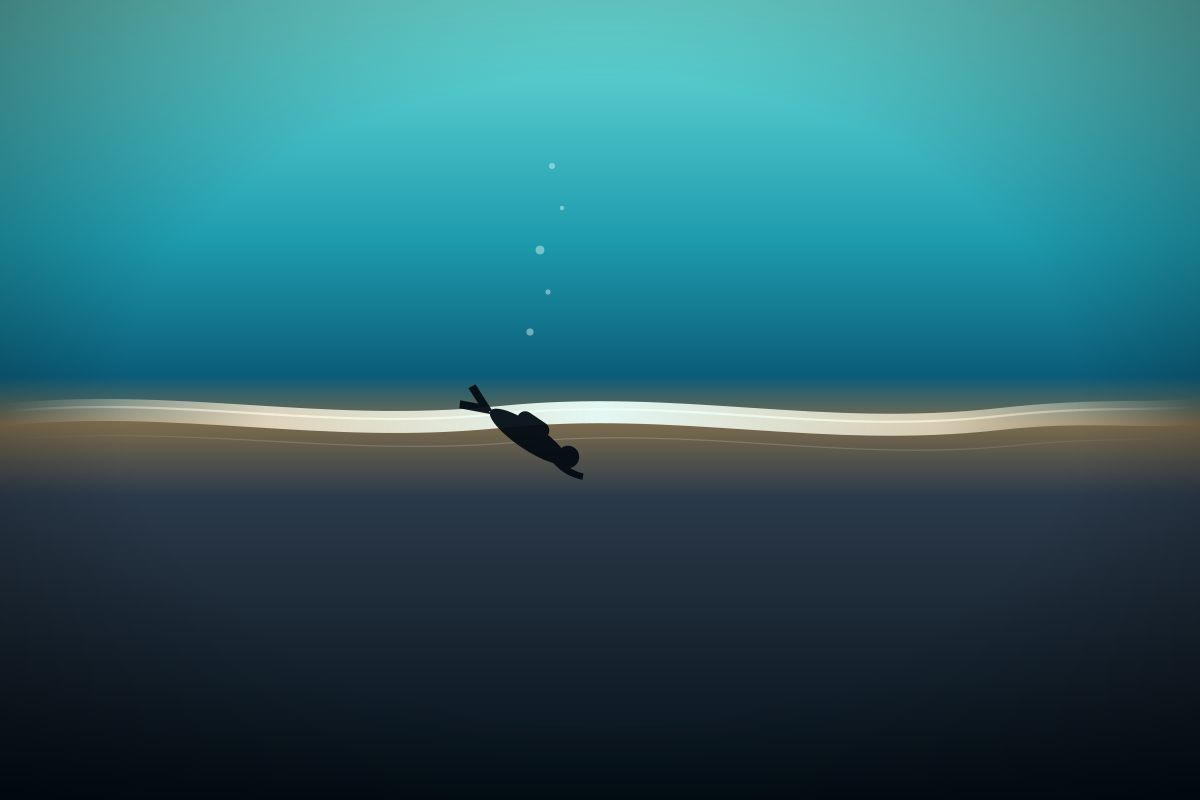
A diver gliding above the hydrogen sulphide cloud of Cenote Angelita, among dead branches

Dive map

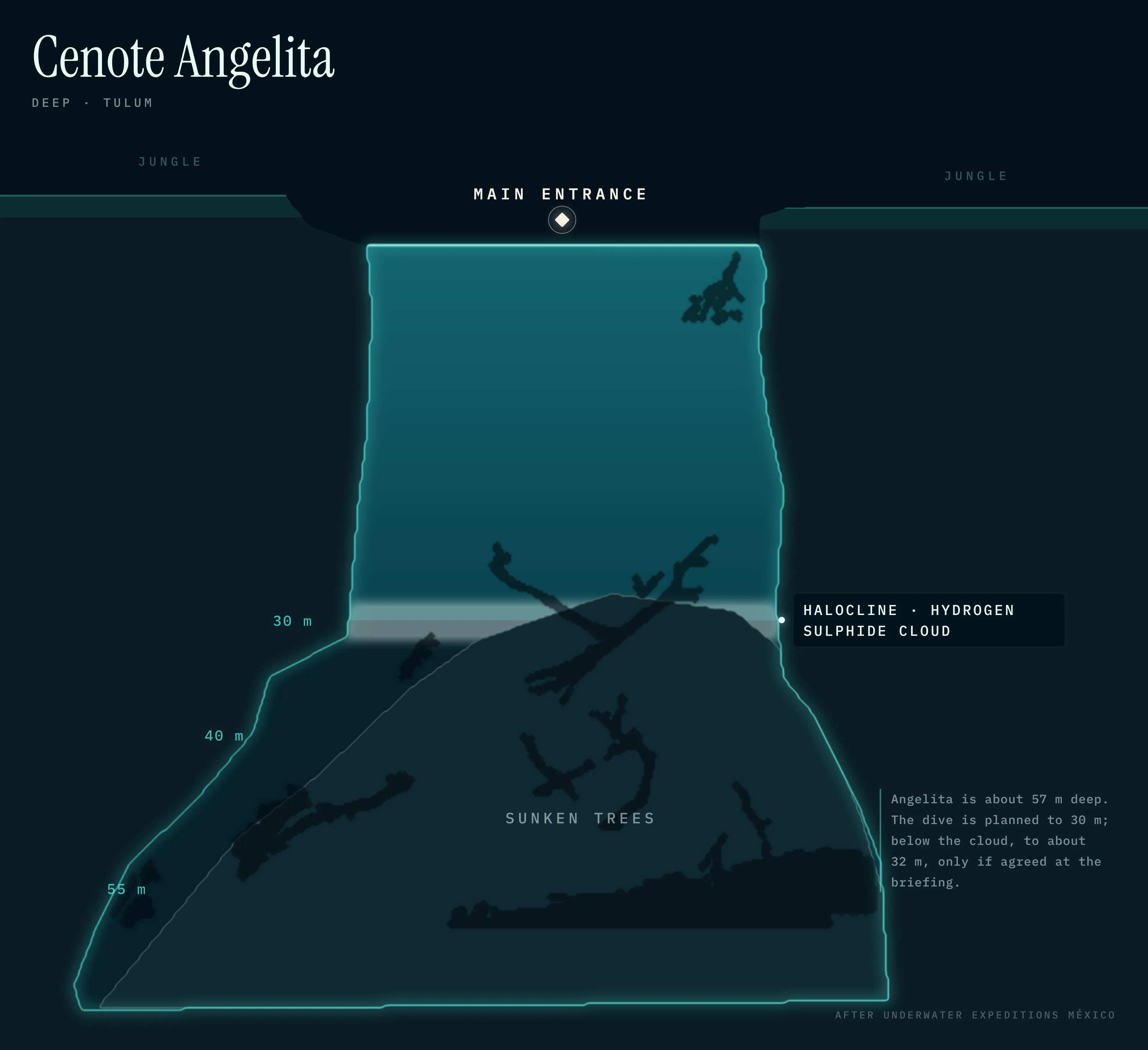
Cross-section of Cenote Angelita: the entrance, depths to 55 m, the hydrogen sulphide cloud at 30 m and the sunken treesOpen full size ↗
Drawn for orientation, not navigation: your guide briefs the route at the cenote. Redrawn from the map by Underwater Expeditions México.

The entry and the descent

You get in by walking down a small wooden platform to the water. Fins on there, and a giant stride in.

We like to descend close to the platform so you can use the wall as a reference. At the start there is only water around you, nothing obvious for your eyes to hold on to.

Why the water looks green

Visibility at Angelita is its own thing. The water runs green, from the vegetation reflecting in from outside and above all because this cenote is not connected to any other cave: it has none of the constant water flow that Dos Ojos or El Pit have, and that flow is what makes theirs so clear. Angelita's is good — just not as good as most of the others.

The cloud and the island

As you near the bottom the island starts to appear. It is a mound of debris fallen over thousands of years, and its summit sits just above the hydrogen sulphide cloud. The cloud looks like a river covering the whole cenote, leaving only that summit out of it — hence the island. With the gas, the mountain and the fallen trees below, the image is completely surreal.

Going through the cloud

The cloud starts around twenty-eight metres. Our dive is planned to thirty. For anyone who asks and has the experience, we can go down through it — it ends around thirty-two — and that is settled with you on site, not sold over the internet. Below it visibility is good but dark, because the cloud eats the daylight; with a torch everything is perfectly clear. We stay a couple of minutes and start back up. Coming back up through the cloud is one of the strangest moments of the dive. Above it the water is fresh; below it, salt.

The U-shaped cavern

We carry on up slowly, circling, to a small U-shaped cavern at about fourteen metres with one way in and one way out. It is narrow, and it gives the middle of the dive a lovely touch.

The ascent and the suspended trees

Out of there we ascend slowly to five metres for the safety stop. That last stretch has very particular rock formations and some trees that fell into the cenote but caught in the rocks on the way down and never reached the bottom. A few of them look suspended in the water.

Angelita in popular culture

A piece of trivia I enjoy: years ago Angelita was on the History Channel's Ancient Aliens, because the cenote fits an Olmec legend that describes a place like it. In that world of theories, some believe the Olmecs were in contact with other civilisations. It is popular culture and myth, nothing more, but it is part of what gets talked about down here.

When to go

The best light is roughly between nine and twelve in the morning. And if you arrive early, you can have the place almost to yourself for an hour.

Going on your own

You can snorkel here, but honestly I would not recommend it. What makes Angelita special is at thirty metres, and for snorkelling there are far better places near Tulum.

Questions

What is the cloud at Angelita?

A layer of hydrogen sulphide that begins around twenty-eight metres. From above it looks like a river covering the whole cenote, leaving out only the summit of the debris mound on the bottom — which is why it is called the island.

Can you go through the cloud?

The dive is planned to thirty metres. For anyone who asks and has the experience we can go down through it; it ends around thirty-two. That is decided with you on site, not over the internet. Below it is dark because the cloud absorbs daylight, but a torch shows everything, and we stay only a couple of minutes.

What certification do I need?

Advanced Open Water or Deep Diver. That is not our rule — it is the depth.

Why is the water green?

The vegetation outside reflects in, and above all Angelita is not connected to any other cave. Without constant water flow it does not clear the way Dos Ojos or El Pit do. Visibility is still good, just not as good as the others.

What time should I dive it?

Between nine and twelve for the light. Arrive early and you may have the cenote almost to yourself for an hour.

Can you snorkel at Angelita?

You can, but I would not recommend it. What is worth seeing is at thirty metres; for snorkelling there are better cenotes nearby.

A diver crossing the halocline, the shimmering layer where fresh water meets salt.
A diver crossing the halocline, the shimmering layer where fresh water meets salt. An illustration of the kind of dive, not a map of this cenote.

Loading the map…

Nearby

A rope hanging over the clear water of Cenote Car Wash, fringed by jungle, near Tulum16 M

Cavern

Cenote Car Wash

Aktun Ha

Kay's favourite cenote, and one of the best to start with. A short, shallow dive that gives you the loveliest postcard of them all: the open water seen from inside the cavern, looking out. Its Maya name is Aktun Ha; the name Car Wash came from the cars that used to stop and get washed at the roadside.

Card to show
Open Water or equivalent
Snorkel
Good for snorkelling too
See the cenote
The clear turquoise water of Casa Cenote, ringed by mangrove, near Tulum9 M

Open cenote

Casa Cenote

The odd one out. Casa Cenote is where a system of underground rivers ends and empties into the sea, so its water is brackish — fresh mixed with salt — and a degree warmer than anywhere else. That gives it wildlife no other cenote has, a crocodile among it. No certification needed, and it is an excellent place to snorkel.

Card to show
None — try it with Discover Scuba
Snorkel
Good for snorkelling too
See the cenote
The turquoise water of Cenote Nohoch Nah Chich under a rock overhang, wooden steps leading down into itTO 8 M

Cavern

Cenote Nohoch Nah Chich

Part of one of the longest underwater cave systems in the world. It is known for an astonishing concentration of stalactites and stalagmites, many of them huge, forming real stone “forests” underwater. Its crystal-clear water and intricate passages make it a must for experienced cavern divers looking for formations on another level.

Card to show
Open Water or equivalent
See the cenote